Showing posts with label Saving Money. Show all posts

2017-11-09

Be Responsible For Your Own Financial Security
by Denis Waitley
There is no job security. You can’t rely on staying with the same company through retirement. Pension plans, when available, are woefully inadequate. Social security benefits won’t come close to covering your living expenses in retirement.
The only way to reach financial security is to plan for it now, regardless of your age. You have to define financial security in your own terms. Have you defined the amount of assets that you need for financial independence?
Financial security is that amount of assets that will give you a specific income, after taxes, to live like you want to, without having to depend on day-to-day employment.
What is that amount for you? I believe it is more than you think. And, I feel that if you define it, you can reach it in ten years or less. Do you have a financial plan and the assistance of a financial planner?  You need both. Always retain a financial planner on a fee-for-service basis. Don’t mix financial planning with an investment broker or insurance agent. What are your financial goals and what is your time line? Because I started late in my quest for financial independence, I have a maximum five-year period remaining for capital accumulation.
Action Idea: Wealth is not only based on income, but also on expenditures. Are you spending or investing?  Are your purchases goal-achieving or tension-relieving? How do you use credit cards? Use your credit cards for services or purchases that retain their value or that build your business. Don’t use credit cards for vacations and personal entertainment, unless you plan to pay the entire balance in one or two months. Try to pay all your balances in full monthly. In this way, you avoid the ridiculously high interest payments. Realize that paying minimum balances, at high interest rates, means that you are paying two or three times what the original purchase was worth.
Most importantly, save at least 6 to 10 percent of your take-home pay each month, by writing a check into a savings account or mutual fund for that amount, as if it were a utility bill or house payment. The secret of most self-made multi-millionaires is compound interest. If parents saved one dollar each day for their newborn infant, by going without a cup of Starbuck’s coffee, or a Big Mac, or a soft drink for that day, by the time the child reached age forty, he or she would have a million dollars cash. No lottery windfall. No brilliant investment strategy. Just compound interest, which Baron von Rothchild labeled “The Eighth Wonder of the World.”


2014-10-18

How To Get Well Water Without Electricity


Written by: Rich M How-To May 5, 2014


Considering that most disasters can cause serious disruptions in the water supply and the importance of water for survival, putting in a well is a great idea. Of all the possible sources for water, having a well on your own property is the most secure source you can have. Even so, if the grid goes down, that water could be out of your reach, if you don’t take the right precautions.

There are two basic types of wells — shallow wells and deep wells. Shallow wells are usually limited to about 25 feet or so. Many “homemade” wells fall into this category. While they might not provide water that is as good as what you can get from a deep well, they are much easier to install. They also have the advantage that the water can be drawn out of them from a pump on the surface, which draws the water out by suction.

Deep wells can’t use a suction pump to draw the water, simply because nobody can build a pump with enough suction to draw the water that far up a tube. Instead, the well has a waterproof pump at the bottom of the well casing. This type of pump can work with pumps that are quite deep.

Both of the types of pumps I just mentioned are electrically powered. Today, this is the most basic type of well pump there is. However, those electric pumps won’t do much good without electricity. In order to get water out of your pumps in a grid down situation, you’ll either need some source of electricity or you’ll need a pump that is powered by some other means.

Of course, if you are producing your own electrical power from either wind turbines or solar panels, you will be able to operate your well’s pump, even if there is no other source of power available. All you would have to do is to disconnect the pump from its normal source of power and connect it to your own power in order to keep it going. This is even a case where the high cost of running a generator would be justified. However, if you don’t have any electrical power production, you’re back to square one, needing another way to draw the water from your well.

Check Your Water Level

Let me tell you a secret here; even if you have a deep well, with a pump at the bottom of it, the water level in your well may not be as deep as you would expect. Wells are often drilled much deeper than necessary to find water, because the water that can be found deeper is usually better water than what can be found up close to the surface. In other words, even if you have a well that’s 300 feet deep, the surface of the water might only be 25 feet below ground level.

It’s easy to check how close to the surface the water in your well is; all you need is an empty pill bottle and some string. Put a few pebbles or metal nuts in the pill bottle to give it some weight and tie the end of the string securely to it. Just don’t put enough weight into it to prevent the bottle from floating. Start letting the string out, lowering the pill bottle into your well. When the string goes slack, you’ve found the water.

Mark the point on your string where the pill bottle hit the water and pull it back out. Measuring how much string you had let out will let you know how far the water comes up in your well casing. Keep in mind that drawing water out of the well lowers the level of the water in it. So if you had just been running the water, your normal water level may be even higher.

The Old Standby – the Manual Well Pump

If your water level is 25 feet or less below the surface, then you can use a manual well pump to draw water out of it. You’ve probably seen these; the squeaky cast iron pump that was used in the Old West (and other places). You can still get them today for a fairly reasonable price.

The electric pump your well has in it won’t prevent you from using a manual pump of this type. If your well is a deep well, it will probably have a four inch well casing. Besides the water, the only thing that is taking up space in that well casing is the power cord and the hose that is carrying the water to the surface. There’s enough room for the suction hose for the manual pump. If your well has a two inch casing with a surface mounted pump, you’ll probably need to pull out the suction pipe in order to put the hose for the manual pump in it.

Build an Emergency Pump

There are a number of designs around for homemade well pumps, generally made out of PVC pipe. These all work either by positive displacement (the water in the well taking up the space of the piston) or vacuum (creating a vacuum source to draw the water up the hose or pipe). Of the two, a positive displacement pump will draw water from a deeper level than a vacuum pump will; however a vacuum pump is easier to build.

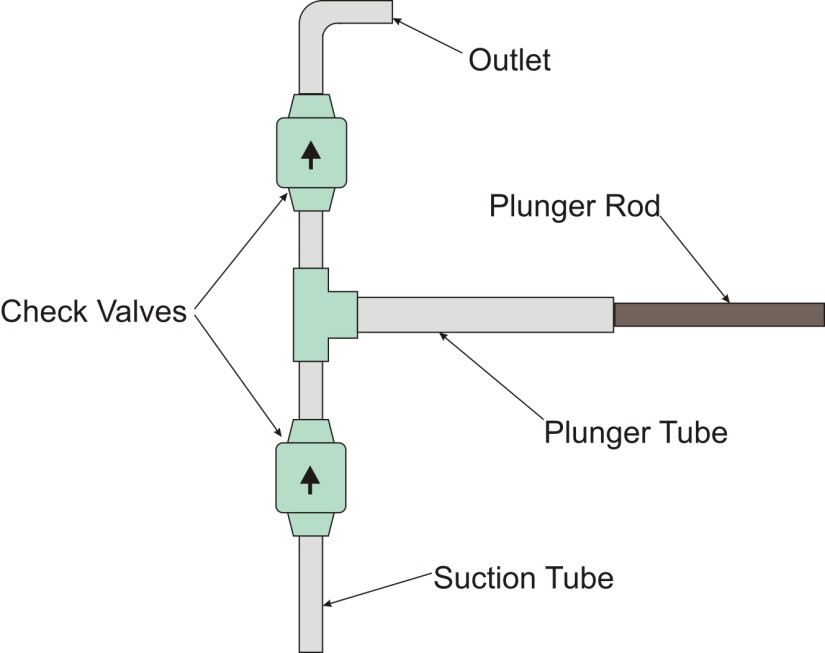
There are two keys to making any type of vacuum pump. The first is having a couple of check valves. These allow water to flow through in one direction, while blocking it from flowing in the opposite direction. The direction through which the water will flow is marked on the side of the valve. The purpose of the check valves is to ensure that water which is pulled up out of the well doesn’t go back down. The other important key is a good seal for the piston which creates the vacuum. If the piston doesn’t have a good seal, you’re going to waste a lot of energy pumping, for very little gain.

Thicker seals work better than thin ones, as they can’t fold out of the way from pressure. With deeper pumps, multiple seals are especially useful, as they will do a better job of ensuring that the pressure can’t make the seal fold, letting air slip by.

The easiest way to make a vacuum pump for a well is a “T” configuration, with the T lying on its side so that the vacuum section is offset to the side of the line of the well. This needs to be between the two check valves, so that the water can be drawn up the pump’s suction tube on the suction stroke and then pushed out the end of the pump on the return stroke.

Both check valves must be pointing in the same direction, that of moving the water up out of the well as indicated by the arrows in the drawing. The suction tube can either be plastic pipe or flexible tube. The thinner the tubing’s overall diameter, the easier it will be to use, but the bigger the diameter, the more water it will draw on each stroke; however, the pump will be harder to operate. For most people, 3/4 inch PVC pipe makes a good pump.

The main PVC pipe diameter, for the suction tube, check valves and outlet don’t have to be the same size as the plunger tube and rod. Since the plunger tube and rod determine the volume of water drawn per stroke, it would make sense to make them slightly larger than the suction tube.

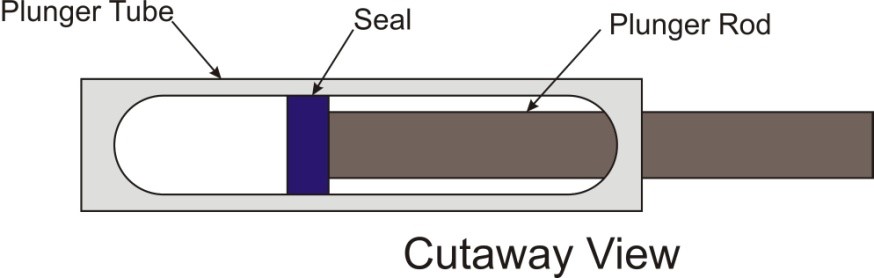
The plunger rod pushes a rubber seal or piston in and out of the plunger tube. This needs to be a snug fit for the pump to work. While there are many different places you can cut the rubber for this seal from, I have found that the inner sole from an old rubber sandal works well. Likewise, the rubber from a flip-flop can be cut for a seal.

well waterThe plunger rod needs to be slightly smaller than the inner diameter of the plunger tube, so that it can move freely. However, it should not be much smaller, as it needs to support the seal. A hardwood dowel works well for this. Attach the seal to the end of the plunger with stainless steel screws so that they won’t rust. The excess plunger rod can function as a handle or you can attach a handle to it.

When the plunger rod is retracted, it creates a vacuum in the pump, drawing water out of the well. The upper check valve will ensure that none of the suction is wasted into the air, while the lower check valve will keep the water from returning back down into the well. Be sure not to fully retract the plunger rod from the pump, or the suction will be lost and the water will spill out the open end of the plunger tube.

Pushing the plunger rod back into the tube causes the water to be pushed up past the upper check valve. Since the lower check valve will be closed, none of the water will return back down the well.

This simple pump will allow you to get adequate water from your well, even without electrical power. You will want to be cautious with your water usage, as it will take time to draw enough water to fill a bucket. Nevertheless, you will have a pretty much limitless supply of water, as long as you take the time and energy to operate your pump.
2014-06-09

Why older couples are living together, skipping marriage


Sharon Epperson | Sunday, 8 Jun 2014 |


Many baby boomers already know a thing or two about marriage and are choosing not to tie the knot on their relationships—often because of money.
U.S. Census Bureau data shows adults older than 50 are among the fastest growing segment of unmarried couples in the U.S.
Financial advisors say concerns about debt, benefits, taxes and cash flow are often the primary reasons they decide not to walk down the aisle.
"The biggest considerations couples have in deciding whether or not to remarry usually center around their children and assets," says Molly McCormack, a director of individual advisory services at TIAA-CREF.
If you're divorced and chose to remarry, you could lose alimony, pension and Social Security benefits from your former spouse. If you're widowed, you could also lose survivor's pension benefits, McCormack says.
Some couples may also want to make sure inheritances go to their own children and don't get muddled.
A partner may also be helping out adult children financially—by paying off student loans or cosigning on a mortgage—and the new partner doesn't want to take on that financial burden. In addition to mortgage, student loan and credit card debt, long-term care and medical debt are frequent concerns.
Under the law in "community property" states—Arizona, California, Idaho, Louisiana, Nevada, New Mexico, Texas, Washington, and Wisconsin—most debts incurred by one spouse during the marriage are owed by both spouses.
Many higher income couples also don't want to face a bigger tax hit. Getting married could throw them into the highest tax bracket which would result in a much higher tax burden.
But when two people live together, money matters can be murky. Financial advisors say it is important to make expectations clear.
  • Be specific with one another about expenses and who will pay for what. Determine what is yours, mine and ours.
  • Make sure assets are properly titled, including the home you live in and other property and/or small businesses.
  • Have a will, health care proxy, and power of attorney for finances. If you want your partner to have certain assets or to have control over your medical care or finances, if you are unable to do so, you must have in writing in the proper legal documents.
"Make sure you communicate your wishes in your estate plan with your children too," says New York-based financial advisor Stacy Francis. "Avoid any surprises."
Most important, whether you choose to say "I Do" or not, make a vow to always be financially independent.

2014-02-01

Easy Homemade Skin Moisturizer


Easy Homemade Skin Moisturizer
and Soothing Cream:
Great for Eczema and Other Skin Conditions
by Cassie on April 30, 2012

Are you are looking for a nice recipe for a simple, yet luxurious homemade skin moisturizer containing 
oatmeal for a soothing, skin softening and moisturizing cream?  Possibly one that can be used as a a
great option for eczema and other skin conditions without paying the hefty price? Then check out our
personal homemade recipe for our easy homemade skin moisturizer. We have a son with eczema and 
the creams you buy can be very pricey! So I combined many of the common components used in many 
eczema and other skin moisturizer creams to create this soothing skin cream.  And at least for our son, 
it works well for his eczema!
In addition to treating our son’s eczema, this has been an amazing treatment for our dry skin.  If we
are experiencing some really dry weather causing those dry, cracking hands, we’ll lather this cream 
on our hands and cover with a pair of socks or gloves to soak it in all night.  It works amazingly well 
in our dry climate!
Here are the ingredients needed:
  • 1/4 cup of oatmeal/oats
  • 3/4 cup of coconut oil 
  • Few drops of rosemary oil
  • 1 tbsp of olive oil
Now that you have your ingredients  together – let’s get started on making a super Easy Homemade 
Skin Moisturizer!
How to make Easy Homemade Skin Moisturizer:
  • You will first need to finely ground the oatmeal to a powder/flour consistency.  You can use a 
  • blender, food processor or a Magic Bullet type of appliance to finely ground the oats.
  • Over low heat, melt the coconut oil until it has a liquid consistency.
  • Add a few drops of Rosemary Essential Oil
  • Then mix in the oatmeal flour until well blended.
  • Mix in the olive oil until well blended.
  • Once the ingredients are mixed, pour into a small storage container or glass baby food jars, etc. 
  • Let harden for several hours.
After it hardens, simply apply to hands and skin as needed for skin softening, moisturizing, soothing and
healing.  This stuff also lasts forever!

2014-01-26

Eight Habits to Turn 'New Money' into 'Old Money'


Interesting thoughts from Bill Bonner:


Dear Reader,

What distinguishes "new money" from "old money"?

I'm often asked this question because I recently set up something called a "family office." The aim of a family office is to perform this feat of alchemy. It must take money that's earned today... and make sure it's around for the next generation.

Most people think preserving money is all about what stocks you pick and which money managers you employ. Not at all.

What matters most is the right family culture. Families with old money all have their own norms, values and no-nos. These largely determine their success or failure over time.

What follows is a list of eight taboos for families who want to create "old money." You will have your own list. What's important is that you spend time instilling the values on your list in your kids and grandkids. Your family's success rests on their shoulders.

1. Consuming, not Producing

Give $1 million to an average person, and he immediately thinks of what it will buy. But give a million to an old-money family, and it goes into a business... an investment... or a new entrepreneurial venture.

What matters for old money is producing, not consuming. We don't want to consume goods and services. We don't want to consume information and ideas. We don't want to consume Wall Street's fee-stuffed products for high-net-worth individuals, either.

Let others drive their fancy cars, carry their expensive handbags and have their addresses in the chic zip codes. Old money doesn't show off by buying things. It prefers to keep a low profile... and a low cost of living.

Old money knows that investment costs have to be kept down, too. The best way to do that is to avoid hedge funds and structured products. Stick with simple, low-cost, long-term investments.

2. Spending the Family Fortune

"Never touch the capital" is a hallowed tradition among old-money families. You may spend the interest on the family fortune – even the capital gains it produces. But woe to the heir who draws down the principal.

The principal must be kept intact. Any distributions should be of interest, after taxes and inflation adjustments. At today's low interest rates, it is hard to earn much income – safely – from your investments.

Families are tempted to "dip into capital" to make ends meet. There's a taboo against it for good reason. Once you begin living on a previous generation's savings, you will find it hard to stop... until the family fortune is all gone.

"Eat only what you kill" – as our family governance strategic partner, Joseph McLiney, put it at our recent Family Wealth Forum in Nicaragua – it is a better way of expressing the taboo against spending family wealth.

It allows you to spend only what you make yourself. The earnings from capital go back into the family fortune, replacing losses from inflation and taxes.

3. Doing What Others Do

Most people want to fit in. They seek social approval by doing what other people do. But if you do what other people do, you will get the results that they get. You will become average... just like they are.

Having wealth is rare. Having it for more than one generation is rarer still. You don't do that by doing what other people do. You have to think more clearly... and avoid many of the ideas, values and habits that most people have.

You must be willing to be different. Sorry. But that's the price of having old money.

4. Making a Public Spectacle of Yourself

Paris Hilton may have enjoyed getting her face in People magazine. But the Hilton family didn't like it at all. Old money likes to keep things private. It favors private businesses, private information, private investments and private lives.

Private businesses are more profitable to their owners than publicly quoted stocks. They pay fewer legal and accounting fees and spend much less money trying to please investors and the media.

Today, publicly traded businesses in the U.S. distribute a measly 2%-3% of their profits to shareholders. A privately owned and controlled business, on the other hand, may return significantly more of its earnings to shareholders.

It may give the owners corner offices, too. In a public company, much of the earnings go to pay CEOs and corporate managers. In a privately controlled corporation, the owners decide who gets the money.

Old-money families also learn to discount public information – the stuff you get from newspapers and TV. They put a premium on their private information sources. They trust their own eyes and ears... and their personal contacts.

This attitude informs old-money families' investments. Rather than invest on the basis of what everybody knows, they try to pin their investments on what they know that other people don't. Deep knowledge of particular industries is developed. Special "family secrets" are encouraged.

Jobs, financing, insurance and a helping hand are available when needed. Old money looks to private sources – primary among them the family – for what it needs.

5. Too Busy to Make Money

It's capital that counts, not income. Most people – even high earners – are on a treadmill. They earn. They consume. There isn't much left. Since their consumption depends on their income, they are eager to increase their income at every opportunity.

Not so with old money. It knows that in the long run, income barely matters. It knows, too, that expenses normally rise with income, but not with real capital gains.

In other words, when you earn more money, your taxes rise... and you tend to spend the extra money on lifestyle enhancements. But if the value of the family farm goes up, the extra wealth tends to stay put. (See No. 7 below.)

Old-money families don't care as much about income as they do about capital. Often, they live in houses that were bought many years ago (no mortgages)... they drive cars that were fully depreciated during the Clinton administration (no car payments; no loss in value)... and they eschew costly fads and fashions of all sorts.

The typical young person is encouraged to go out and get the best-paying job he can find. Then he enters the labor force and spends the rest of his life trying to stay ahead of his expenses. He becomes a living example of the old expression, "Too busy to make money."

I tell my children: "Don't worry about how much you make. Worry about what you learn... and what you end up with. Tell your employer you'd rather have equity than a salary increase."

This is true in your careers. And it is true in your investments. If you worry too much about the current yield, you are likely to miss the real payoff later.

Trading out of winning stock positions, for example, can trigger taxes and incurs trading costs. In your work, as in your investments, you are better off ignoring income and short-term gains in favor of long-term capital growth.

6. Trying to Beat the Market

We all have seen the study results. Most of your investment profits come from being in the right market at the right time (beta), not from picking individual stocks (alpha).

Trying to beat the market is a losers' game. You can count on two hands the number of professional money managers that do it with any consistency. Most individual investors end up having the market beat them.

If you stick to the romantic notion of beating the market, sometimes you will get it right. Other times you won't. Over the long run, you will make too many mistakes and probably end up poorer than when you started.

It is better to find a decent market – a beta position – and sit tight. Trading in and out of it... or moving from one market to another... is usually disastrous. The results over the last 30 years, for example, show that an investor in oil, gold, stocks or bonds – had he simply just sat on his positions the whole time – would have had an average annual gain three or four times as high as the average investor during that period.

Why?

Because the average investor couldn't sit still.

I use the term "beta" in a broader sense, too: It is important that you and your family are in the right place at the right time.

One hundred years ago, for example, Russia had one of the fastest-growing economies in the world. But it didn't matter how good an investor you were. If you had stayed in Russia at the turn of the last century, you would have lost all your money. Stocks, bonds, real estate – all were confiscated by the Bolsheviks. And your family would have waited two full generations before it could begin rebuilding its wealth.

That's why we spend so much time trying to understand what is going on in the world. Beta matters.

And we're not alone. A report in a recent Financial Times tells us that most rich people "make the same investment mistakes as the rest." In short, they go with investment fashions – notably hot hedge funds – rather than sticking to a sensible long-term discipline.

But "the richest of the rich... are different," the report concludes. They "started liquidating their portfolios and slugging money into cash as early as the summer of 2007. [T]he suspicion has to remain that the very wealthiest escaped into cash because they, almost uniquely, understood the gravity of the situation."

Why? Because the richest were focused on beta. And they weren't distracted by alpha.

7. Selling the Family Farm

Ordinary people need liquidity. Banks need liquidity. The whole financial system needs liquidity. But it's illiquidity that works for old money.

Families fare best when they have old assets that are hard to buy, hard to run and hard to sell. A family farm, for example.

It's not easy to sell a family farm. Family members develop a sentimental attachment to it. It's hard to get all the family to agree on a sale. And you usually can't sell it in pieces. You can't fritter it away. It's all or nothing – a big decision that takes time and reflection.

Families tend to hold onto their illiquid assets... and they grow.

8. "Na... Na... Na Live for Today"

Old-money families know they have to give up something today to have more tomorrow – accepting a short-term disadvantage for a long-term strategic advantage.

Great businesses, great families and great fortunes take time. You have to be willing to invest time and effort... and wait for the payoff sometime in the future. Old money knows how to delay gratification, in other words.

As Albert Einstein noted, compound interest is the ninth wonder of the world. But it only becomes a miracle at the end, not the beginning. That's when you get the huge increases that create real family fortunes.

These are 8 lessons I've learned from old money families about how to preserve wealth for generations. If you want details about how to put these ideas into practice and create a legacy of wealth for your family, then I hope you'll fill out the Declaration of Interest form to find out more about my project, Bonner & Partners Family Office.

This is the last email you will receive from me in this series. So, if you're interested in what I've shared with you about building a family legacy, I do hope you'll take the time to sign up and learn more about what I'm doing with my own money and Bonner & Partner Family Office.

Sincerely,

 
 by Bill Bonner, Chairman, Bonner & Partners

Bill Bonner
Editor, Diary of a Rogue Economist